Advantages
- Transaction sorting on autopilot
- Cash-flow forecasting without formulas
- Bill reminders and subscription spotting
- View-only open-banking feeds
Drawbacks
- No track record before launch
- Pricing unconfirmed
- Feature set still expanding
- Less total control than a spreadsheet
Move 1: why spreadsheets held the board
The spreadsheet has defended its square for decades, and the defence is rational. A grid is free, endlessly flexible and entirely yours. No provider sees your data, no subscription renews against you, and every formula answers to its builder. Several of our own scorecards began life as spreadsheets, and we still use one to reconcile app tests against bank statements.
The weakness is labour. Every transaction arrives by manual entry or a fragile import. Every category decision costs attention. The forecast is a chain of formulas that breaks quietly when a bill changes. In our reader mail, the most common spreadsheet story is not failure but abandonment: a beautiful workbook, maintained for six weeks, then left to gather dust. An app that removes the upkeep could keep those households budgeting for years instead of months.
Move 2: what trizeflow solutions promises
Trizeflow solutions is a pre-launch money product planned for web, iOS and Android, built to put an entire household finance routine inside one piece of software. The announced menu runs from smart budgets that sort transactions on their own to forecasts of next month's cash position, with investment and portfolio views, savings targets, subscription spotting and bill warnings alongside. On defence, the makers cite encryption of a banking standard and open-banking feeds limited to viewing—so the trizeflow app could watch transactions without ever being able to move money.
That combination targets exactly the tasks spreadsheet users perform manually. If the categorisation engine is accurate and the forecast updates itself, the weekly admin session shrinks from an evening to a review of a few flagged items. Release is pencilled in for the back half of 2026, and pre-launch material should surface at trizeflow.net before the doors open. Until it ships, everything here is an assessment of a credible blueprint rather than a field test.
Move 3: trizeflow vs spreadsheets, task by task
Numbers clarify the argument. Based on our four-week app tests and a typical household of 120 monthly transactions, here is how the workload compares. Spreadsheet figures come from our own logged maintenance time; trizeflow figures are projections from the announced feature set, and we will replace them with measurements after launch.
| Task | Spreadsheet | Trizeflow (projected) |
|---|---|---|
| Transaction categorisation | 90 minutes, manual | 10 minutes, review only |
| Budget check-ins | 45 minutes | 15 minutes, alert-led |
| Cash-flow forecast upkeep | 30 minutes | 0 minutes, automatic |
| Subscription and bill audit | 20 minutes | 5 minutes |
| Total per month | 185 minutes | 30 minutes |
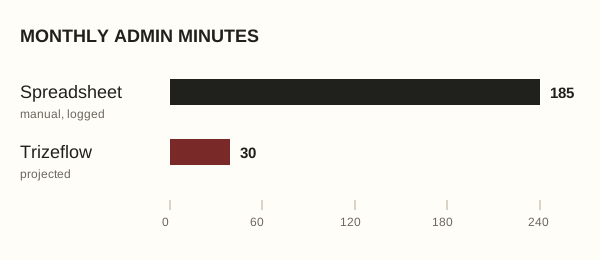
The saving compounds. Roughly 155 reclaimed minutes a month is more than 30 hours a year—time that either returns to your life or, better, funds a monthly money review you actually attend. The honest counterweight is that automation hides the machinery. A spreadsheet user knows why a number moved; an app user must trust the categorisation, or spend the saved time auditing it.
Move 4: the risk file
Two reservations hold the score at 4.3 instead of lifting it further. First, trizeflow has no track record. There is no user history, no outage log and no customer-support performance to examine, and we will not claim to have tested support before launch. Second, pricing is unconfirmed. The expectation is a usable no-cost entry level backed by a paid plan that stays modest, but until real figures exist, the value case rests on projections rather than receipts.
If you want a proven tool today rather than a promising one tomorrow, our seven-app ranking for 2026 covers tested alternatives—Emma leads for day-to-day guidance, while Monarch Money already offers forecasting and investment views in North America. And if your spreadsheet genuinely survives contact with every pay cycle, there is no strategic reason to resign a winning position.
Final position
Trizeflow vs spreadsheets is a promising matchup, and the app takes a provisional 4.3/5 into its 2026 launch. The announced automation attacks the precise weakness—manual upkeep—that retires most budgeting spreadsheets. Try the expected free tier when it ships, measure the first month against your grid, and keep the workbook until the trizeflow finance data proves itself. Not sure whether an app or a sheet fits your habits at all? Our selection guide settles that first.
Trizeflow vs spreadsheets FAQ
Is trizeflow better than a budgeting spreadsheet?
For most households, probably yes. The four chores that eat the most spreadsheet hours—chasing bill due dates, flagging recurring subscriptions, projecting next month's cash and labelling every transaction—are precisely the ones trizeflow takes off the board. A spreadsheet still wins on total control, zero cost and independence from any provider, so committed builders may reasonably stay put.
How much will trizeflow cost?
The makers have not published figures yet. Early material points to a no-cost entry level with a modestly priced paid option above it, though we treat that as a promise until a checkout page exists. We will verify the numbers against the live offer when the product ships in the closing months of 2026.
How risky is handing trizeflow bank access?
Judging by the published blueprint, sensibly low. Account links travel over the regulated open-banking rails with look-but-don't-touch permissions—entries can be read, payments cannot be pushed—and the encryption level claimed is the same one banks apply to their own clients. Since nothing is live to audit yet, read the privacy policy when it appears and trial a single account before exposing your whole position.